Proof of Life
A trans North Carolinan watches the clock, weighing his options
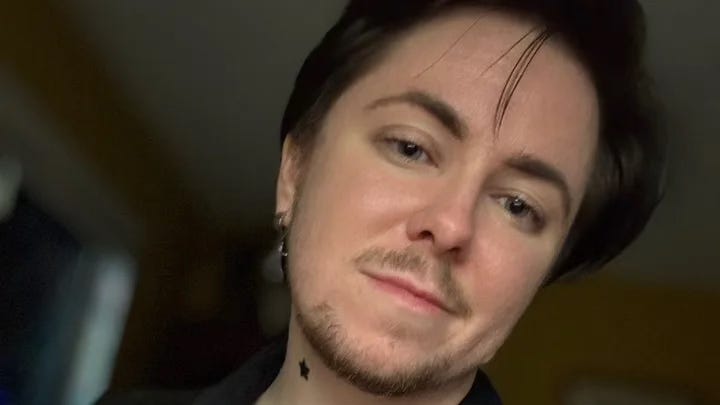
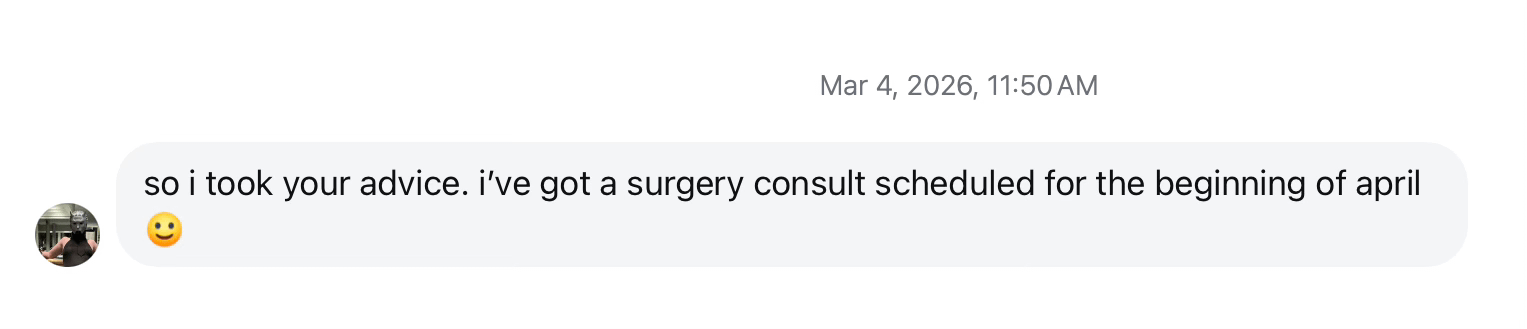
Reader, no one ever takes my advice. But Desi did when we chatted earlier this year about the possibility of his gender-affirming top surgery. My sweet North Carolina friend, whom I socialize with every year at Dragon Con in Atlanta, posted on Instagram about trying to be brave in the face of reckoning that it just wouldn’t be in the cards for him.
“I definitely have a provider who could give me the letters and documentation for a referral, but i havent got much/anything in the way of savings, very little PTO,” he replied to me privately. “My insurance is unlikely to cover anything, which keeps me from even seeking a consult.”
Medical care like this is still considered elective in most states, by most insurance companies, despite the fact that doctor-supported transition is recommended by all accredited medical institutions as the most effective treatment for gender dysphoria. And gender dysphoria is one of the main factors contributing to mental illness and death among trans folks.
Having successfully helped friends crowdfund for similar care, I’d urged Desi to go ahead and book the consultation. “Why not get a number put on that, and then see how far you can get toward it?” I advised. “It can be scary to get one's hopes up when the outcome seems so far-fetched, but also... why not?” I also pointed out that if people saw how sincerely he was pursuing this, they’d be inclined to help.
That last part felt true. But is it? Desi’s surgery will cost nine thousand dollars, out of pocket, with another thousand tacked on to cover aftercare and missed work.
Everyone knows that GoFundMe is functionally America’s backup healthcare provider at this point. I don’t have numbers on how many trans surgeries have been made possible through crowdfunding, but it’s certainly a lot.
Still, my own experience suggests that many (if not most) onlookers have absorbed the influence of the corrupt US healthcare industry and political arena, pausing over cases they consider “elective,” hesitant to extend aid to a “healthy” individual over a sick or injured one whose case seems less “urgent.”
Some may be put off by the wry humor that’s often attached to such campaigns, which was a mild concern I had about Desi’s after he launched it:

But I’m also very familiar with the self-effacing aspects of queer life, which is just one way of showing up (often embarrassingly) as oneself in plain sight of everyone else. Make the joke first. Put people at ease. Endear them with a smile. I strike my own version of this deal least once nearly every day.
Even so, cases like Desi’s will appear side by side on people’s screens with some of the most dire catastrophes one could imagine. It’s understandable to give priority to those who can’t function today without life-saving help.
One friend messaged me privately in response to my posts about Desi’s needs:
Wish I could give but I recently gave a huge chunk to a friend on Medicaid whose diagnostic MRI was refused despite her doctor’s best efforts -- she basically can’t walk due to an early onset back condition that usually doesn’t show up until after age 65 (which is why the dipshits at the Medicaid office won’t approve the scan). Best of luck to your friend. This country sucks.
I know these last remarks weren’t flippant. He will need that luck. And this country does suck.

So far I’ve held up my end of the bargain I made with Desi, hustling through my networks to put his request under as many sympathetic noses as possible. It’s become a daily pastime. I’ve told friends: this is like playing the worst video game in the world.
While this isn’t my responsibility, I’m still something of a community resource. I’m older, I know more people. My people know people. Some of those people have money. We broke it down: how many $100 or $50 donations would it take to get him close to the goal? The number seemed small to me, but to a trans North Carolinan with access to way fewer people, it still must seem like building a staircase to the moon.
Elective. I think about that term a lot. Who would choose all this? That kind of thinking has infected every sector of healthcare. Last year a dentist informed me that I had a cavity on one tooth, but I’d have to pay $150 to get it filled because it hadn’t yet shown sign of decay. “Your insurance describes this as a ‘cosmetic filling,” the dentist told me.
“So I should just come back when it’s worse, or causing me pain?” I asked. She didn’t pick up on my disbelief or my sarcasm, and instead answered brightly: “Yes, or we can fill it today for $150.” So far I’ve been able to live with it.
Six weeks from now, Desi will either wake up from surgery in a form that causes him drastically less psychological anguish… or he won’t, because we were unsuccessful in our crusade.
Or do I have that wrong? Many trans people aren’t just running away from dysphoria, they’re running toward a glorious vision of something they once believed impossible. But it’s harder to raise money for hope and joy, isn’t it? Somehow suffering is easier to sympathize with, to compare and to quantify.
Anyhow, it’s moot: at our current rate, he won’t make it.

Just last year, North Carolina lawmakers overrode their Governor’s veto of H.B. 805, a bill which imposes harsh restrictions on the lives of transgender people and their families. Similar laws have proliferated throughout the country, creating a chilling effect not just on healthcare providers willingness to provide gender-affirming care (which they may now face undue punishments for), but on trans folks themselves.
It’s often repeated that “the cruelty is the point.” I’m more interested in the effects of the cruelty: silence. Hopelessness. Absence. Indifference. In other words, spreading the acceptance of cruelty is the point. It creeps into our own hearts, telling us to lower our expectations.
Personally I find it far easier to campaign for someone else’s needs than my own. There are hopes inside my own heart which have slowly chilled to a point of cryogenic stasis, dreams which I’ve stopped bothering to nourish, withering like neglected houseplants.
So I’m grateful to have been shocked back into motion, even here on JUDGEMENT. Doing for others, even when it seems pointless, is good practice for recognizing what needs to be done for oneself. And I know on some level, if Desi’s campaign is successful, something bright and young will come back to life in me.
I encourage him, sometimes out of worry. The inextinguishable nature of his spark then encourages me. I’m sharing here in hopes that it will do something for you.
xoxo
TB